Stephenson&MollerHI
Tirohia he Huarahi: Plans, Power, Partnerships |
|
| Funding Body | Marsden |
| Total Contract Value | $773,312 |
| Start Date | January 2009 |
|
End Date |
January 2012 |
|
Principal Investigator(s) |
Dr. Janet Stephenson and Professor Henrik Moller |
| Collaborators | Jonathan Dick (Te Maramatanga Consulting); Rauru Kirikiri (RK Associates) |
| Staff Involved |
Rachel Turner; Nicole McCrossin |
Keywords
Governance, tribal identity, transformations, resilience, futures, participation & justice, knowledge systems, cross-cultural research and management
Brief Abstract
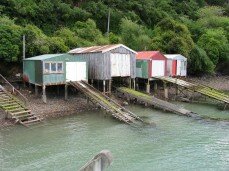 Tirohia he Huarahi: Plans, Power, and Partnerships looks at the barriers to, and benefits that could arise from, active participation of tangata whenua in the management of mahinga kai. A basic premise of the research is that traditional M?ori resource management techniques ? including their continued evolution ? have much to offer national resource management practices.
Where communities have lived in a place for generations, they develop an in-depth understanding of the place, based primarily on their continued use and management of its resources. What happens when they are empowered to use this wisdom and knowledge in hands-on management of those resources? How can this empowerment be achieved? Our research examines these questions, focusing in particular on M?ori participation in the management of coastal mahinga kai. The research is driven, in part, by tangata whenua concerns about their inability to prevent continued despoliation of mahinga kai, their desire to actively fulfil their kaitiakitanga responsibilities, and for a common desire to restore abundance.
Tirohia he Huarahi records the experiences and aspirations of the indigenous guardians of mahinga kai (traditional food-gathering areas). Their testimonies challenge accepted approaches to planning and resource management, and offer new perspectives on adaptive co-management. The project also critically examined the complex legal and institutional framework for devolving responsibility for management of resources to iwi and hap?, and the perspectives of those involved in developing and implementing the law.
Links have also been forged across the Pacific Ocean to Canada, where team members Professor Fikret Berkes and Professor Nancy Turner have developed international reputations for their work with First Nations Peoples in resource management. Exchange visits between Canada and Aotearoa are a feature of the project.
Publications:
Mana Moana, Mana tangata: Testimonies on depletion and restoration of mahinga kai. Jonathan Dick, Rachel Turner, Janet Stephenson, Rau Kirikiri, Henrik Moller. Tirohia he Huarahi Research Report #1. March 2012.
Intention and Implementation: Piecing Together Provisions for M?ori in the Resource Management Act 1991. Nicole McCrossin, Masters in Indigenous Studies, University of Otago. 2011.
Cross-cultural environmental research and management: challenges and progress. Janet Stephenson and Henrik Moller. Journal of the Royal Society of New Zealand, vol 39 no 4, pp139-149. December 2009.
Presentations:
Cross-cultural environmental research and management partnerships: progress and challenges for ethnobiology and science. Henrik Moller, Janet Stephenson, Rachel Turner. Society of Ethnobiology Conference: The Meeting Place: Integrating Ethnobiological Knowledge. Victoria, BC, Canada. May 2010.
Cultural consquences of loss of abundance and biodiversity. Rau Kirikiri, Jonathan Dick, Janet Stephenson, Nicole McCrossin, Rachel Turner, Henrik Moller. New Zealand Ecological Society Annual Conference: Biodiversity: 2010 and Beyond. Dunedin, New Zealand. November 2010.
Resonance of M?ori World View and Social-Ecological Resilience Thinking for Community-led Restoration of Coastal Ecosystems in Aotearoa/New Zealand. Rau Kirikiri, Janet Stephenson, Henrik Moller, Jonathan Dick, Nicole McCrossin, Rachel Turner. Resilience 2011 conference, University of Arizona, Phoenix, Arizona. 11-16 March 2011.
Science and Matauranga Maori: do they mix? Jonathan Dick. Kingitanga Symposium, Waikato University. April 2010.
- Te Tiaki Mahinga Kai (sub-projects)
- Kia Mau Te Titi Mo Ake Tonu Atu - Harvests of Titi by Rakiura Maori
- M�ori knowledge & RMA (Stephenson)
- Modelling M�tauranga (Moller)
- Weka and rat impact studies on the Titi Islands
- Climate Change Impacts on Maori
- Who is catching what?
- Maori Customary Seabird Harvest (Moller)
- Traditional Maori and scientific methods for translocating and reseeding Paua (Haliotis iris)
- Ka ora te whenua, kaora te tangata
- Te Hirringa Tangata Ki Te Tai Timu Ki TeTai Pari - Facilitating bicultural restoration of coastal forests using seabirds as ecosystem engineers
- Te Hononga o nga Au: Joining science and matauranga for ecosystem co-management
- Sustaining toheroa (Paphies ventricosa) in Murihiku
- Applying Matauranga Maori to restore and protect coastal environments
- Restitution of Marae and communities through Mahinga Kai
- Whakamana Whanau: Managing metapopulations using matauranga and science for more productive and sustainable fishing
- Absolving the sins of Emission
- Researching case studies that demonstrate adaption to climate change
- Assessing awareness of and attitudes toward climate change in the New Zealand pastoral sector
- Voluntary Carbon Markets - Analysis of risks and opportunities